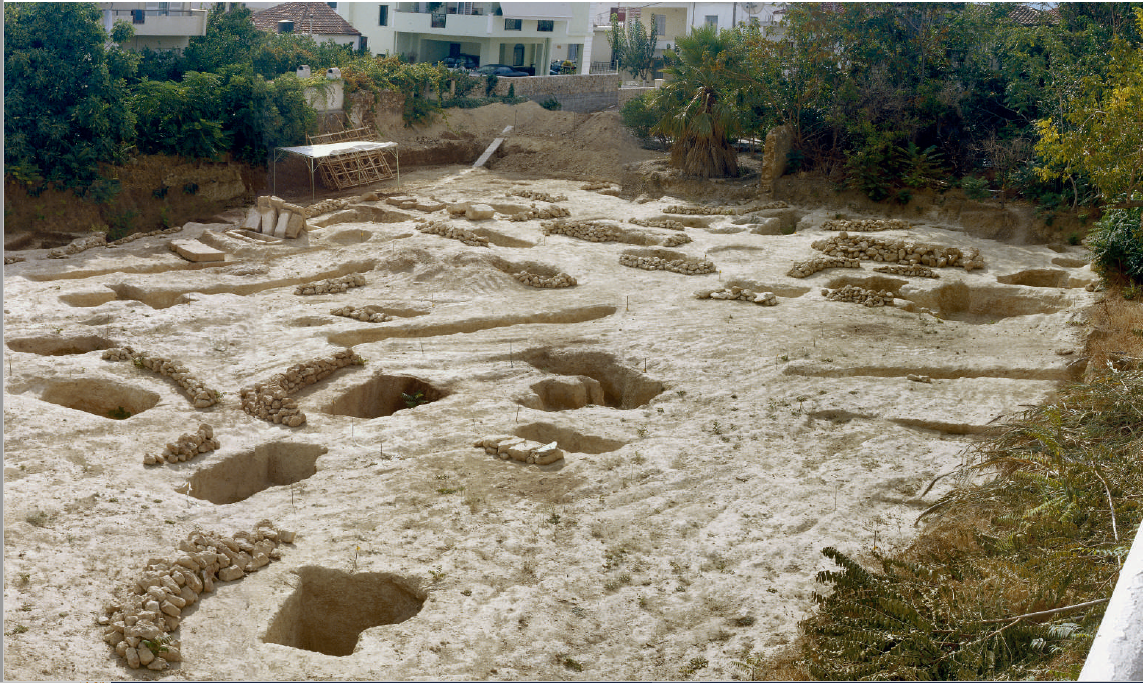
Towards the end of 2003, during a trial excavation for the erection of a multi-storey building immediately east of the church of the Apostles Peter and Paul, one of the most important discoveries in the history of the city of Khania came to light. In particular, 60 tombs, which were cut into an area of 1680 sq.m.. These were grouped as follows:
I) A cluster of seven tombs with a north-south orientation, in the southeast part of the plot, belongs to the early Hellenistic period (end of 4th – beginning of 3rd century B.C.). Six of them are cist graves and one is a pit grave. They are made of sandstone or hard limestone slabs and their interiors are often coated. In total, they were buried with 12 clay vessels, 9 fragments of clay figurines, 12 silver and gold “Charoneia” coins, 3 iron strigils and 3 bronze mirrors, needles, rings and beads. Among the most impressive discoveries are the fragments of two wreaths, as well the teeth of a bone comb. The shells of two eggs seem to be connected with the burial customs of the period. During the Hellenistic period, a big pit for depositing the useless building material had been dug on the west side of the field. Two marble sculptures of fine quality of the 4th century B.C. came to light among the discarded material. They may have adorned a burial monument.
II) Of great importance is the discovery of 54 prehistoric tombs, carved out of the soft marly limestone, and belong to three Mycenaean architectural types as follows:
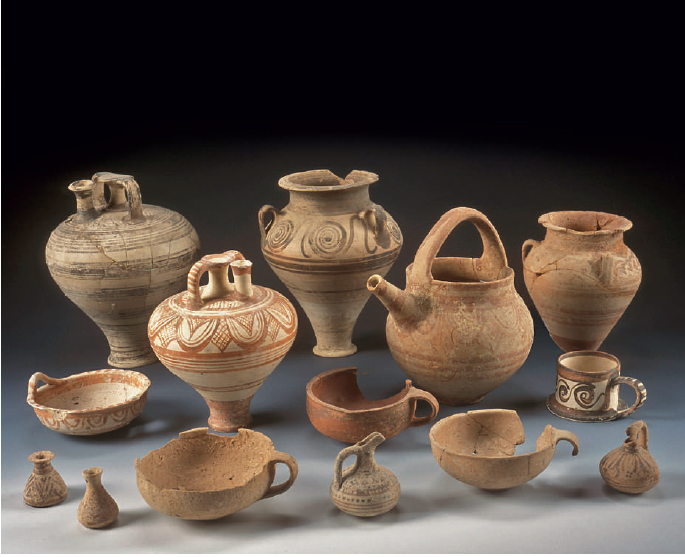
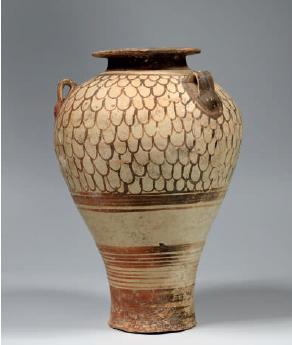
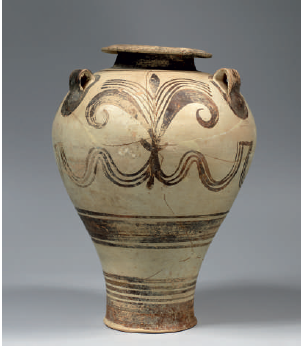
A) Pit-cave.Thirty-two examples, without any standard orientation, were found scattered at the site. They consist of a rectangular trench, in one long side of which a cavernous chamber is made for placing the dead. The chamber was sealed with a strong blocking of “kouskouras” limestone without bonding material, whereas the trench, after the burial, was filled up with the debris of the initial digging out, up to the surface of the bedrock The most monumental piece of architecture of this type is located in the southwest part of the site. A tall, robust man, of about 35 years old, was placed in a supine position, his burial richly endowed. Τwo, large piriform three-handled jars, two highspouted jugs, a silver hair-clasp, a mirror with a bone handle, a bone comb with a relief decoration, a necklace made of 23 glass-paste beads and one large, biconical bead of cornelian, were evidently objects connected with grooming anddressing the dead. Three exceptional seal-stones were found along his left hand.The dating of the grave goods places the burial to the Late Minoan II period, making it the earliest of the tombs discussed here.
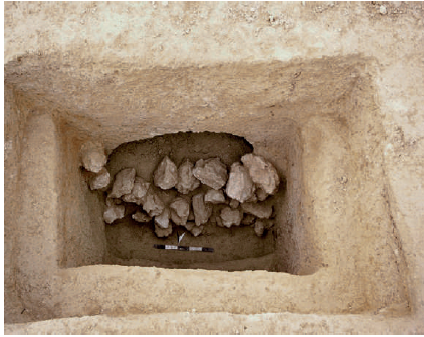
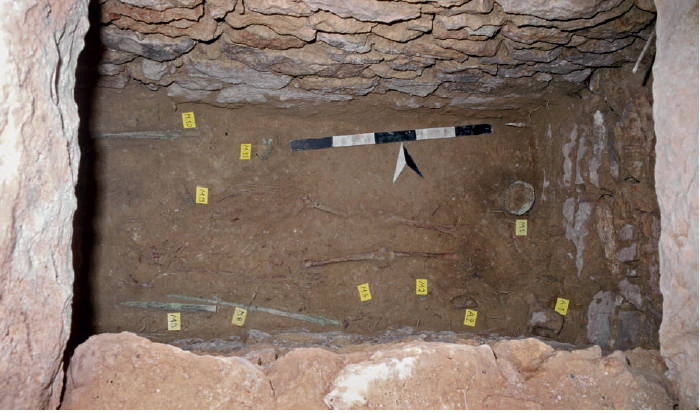
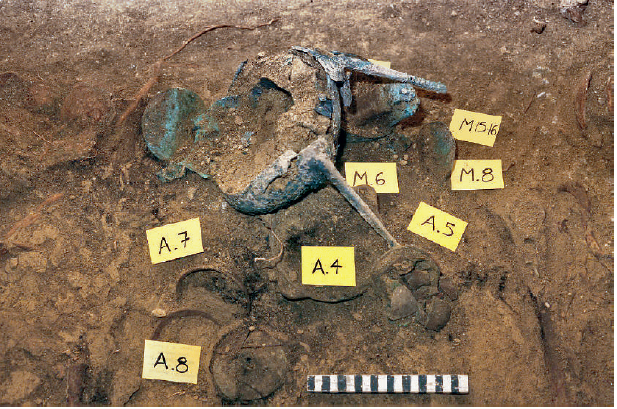
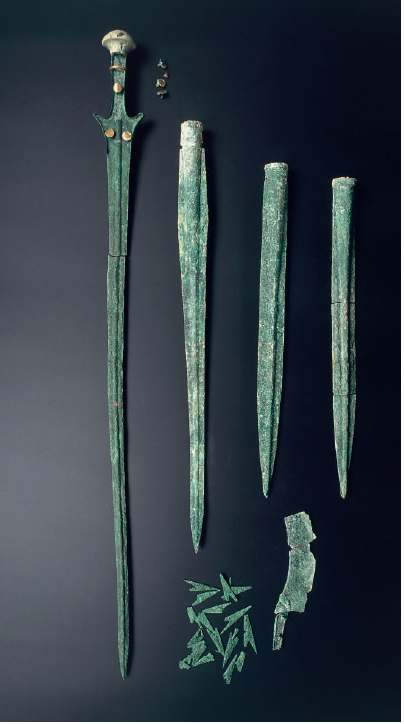
B) Shaft-grave. Six graves of this type were located, scattered over the whole site of the excavation without a standard orientation. They consist of a rectangular, roughly worked pit with the level rock as a floor, strewn with finegrained “kouskouras” limestone in order to receive a single burial with its grave goods. In order to put the covering stones in place, a narrow ledge was created around the edge of the pit. Next, the pit was filled up with the debris from digging the shaft-grave. In total 9 clay vessels and 12 bronze objects came from these tombs, which constitute the smallest group.A built shaft-grave of Mycenaean type, dated to the Late Minoan III A1 phase (1400-1375 B.C.), is included in this category and constitutes the most impressive piece of architecture of the excavation, unique in the archaeological record of West Crete. The rectangular pit consists of four large, oblong slabs of hard “kouskouras” limestone, placed lengthwise and covering the width of the rectangular pit, the gaps in between being filled with rough stones and wedges, which “lock” together, forming a solid surface. The grave contained the burial of a high-ranking warrior, as emerges from the bronze weapons that accompanied him.
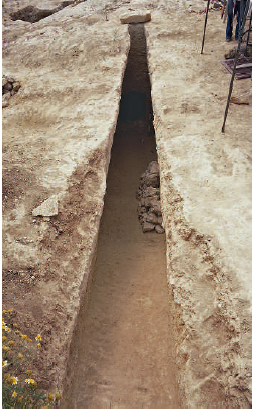
C) Chamber tomb with dromos . The most common type of tomb in the Creto-Mycenaean world is represented in the excavation by 15 examples. The chamber tombs, cut into the rock in groups, have long corridor-like entranceways or dromoi, which descend via inclines and steps. A blocking of rough limestone blocks close off the opening of the entrance to the spacious chamber, quadrangular in plan. The tombs are of a family character and include multiple burials.
The above archaeological discovery is unique since for the first time a set of tombs belonging to warriors, members of the Mycenaean community, was located in the prehistoric necropolis of Kydonia