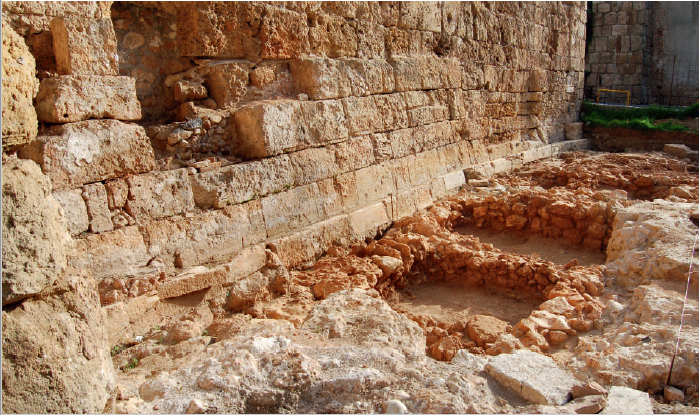
The year 2006, during a test excavation in front of the ancient fortification walls, where Karaoli & Demetriou meets Katre, turned out that under the small intrusions of modern times, prehistoric deposits were preserved, right under the foundation levelof the fortification walls.
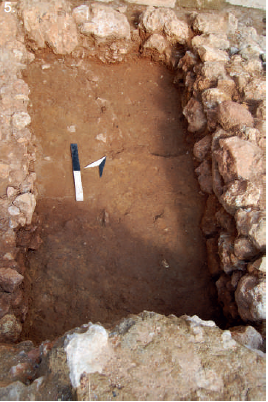
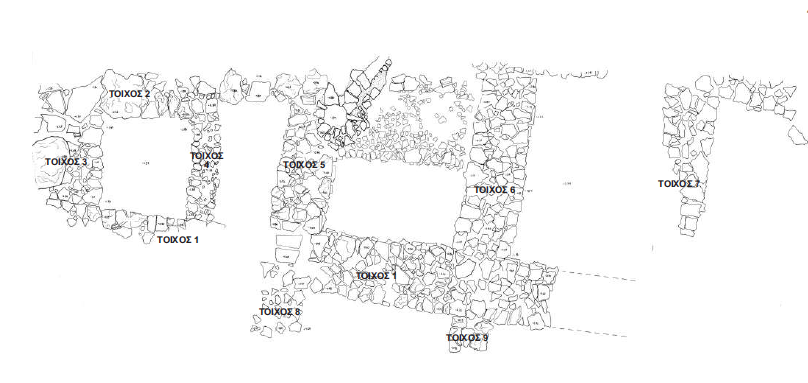
Four spaces, as well as parts of another four, have been recovered in an area of 90 sq. m. The building follows the lie of the land, while the walls are orientated N-S and E-W. The southern wall of the building (Wall 1) borders a row of four rooms and the corner of anotherone at the north-easternmost limit of the excavation.
Following a strict line from west to east, it runs for a length of 10,50 m., while its width, where preserved, reaches 1,20 m. The northern wall of the building (Wall 2) is less well preserved, and has served, to a large extent, as the base of the ancient wall above. The partition walls of the building are particularly well built. More or less parallel to one another, they are 1,0- 1,10 m. wide and each one longer than the one to the west. To the south of Wall 1, Walls 8 and 9 with a preserved length of just 0,80 m. seem to belongto three more spaces. The construction of the impressive Byzantine rampart just to thesouth unfortunately destroyed the continuation of the Minoan building.
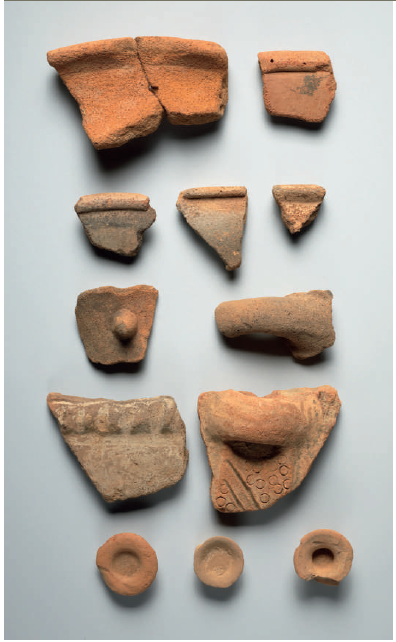
The earth floors appeared under the wall surface and do not match the high quality of wall construction. But then the movable finds are also poor and limited to domestic pottery and some obsidian debitage. In addition, the fact that the building was totally covered by afill of pebbles, rather loose soil and plenty of discarded pottery, combined with the fact that no door openings to the spaces turned up, lead to the conclusion that the spaces in question were basement rooms and that the main rooms were on an upper floor.
Test trenches cut into the floors revealed the virgin, sandy, as is natural, layer with no earlier phase of habitation. The area was however, in continuous use into later periods. The tiny section of a paved floor, at the northwestern limit of the area, is assigned to the Late Minoan I period (1600-1450 B.C.).